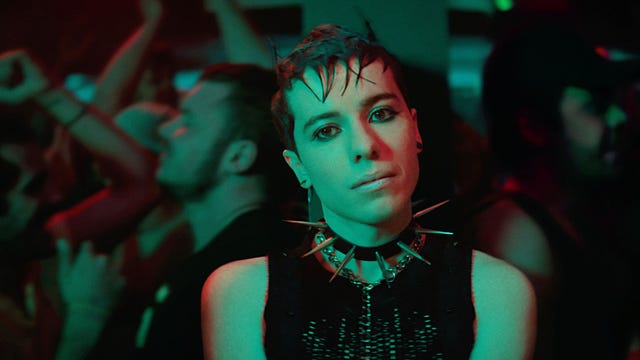
All television is not created equally. Adapted from trans writer and activist Paris Lees’ memoir, and directed by Brian Welsh, Ng Choon Ping and Marie Kristiansen, What It Feels Like For A Girl is absolutely wonderful, a unique account of lived experience. It’s as raw as love bites, hilarious and often heartbreaking. I watched the whole eight episode series in two days, so addictive is its pull. You end up caring about the characters, because they’re based on real life and the cast are completely brilliant.
The narrative is rooted in the early 00s. Culture is mono, a steady stream of bad TV, Pot Noodle and cheap disposable fashion. Britain is in a quagmire of post-lad mediocrity.
At the centre of it all is young Byron, portrayed by Ellis Howard. At fifteen he’s so bored of life in Hucknall near Nottingham, sinking into a millennial torpor, that he hits the clubs, and is befriended by a beautiful queer group called the Fallen Divas, ultimately ending up making some incredibly dangerous decisions.
Essentially, his hedonism and lust for anonymous sex leads him into becoming a rent boy, groomed by dirty old men. In addition to this, spiralling out of control,he becomes embroiled in an extremely toxic relationship with Liam (Jake Dunn) a seductive psychopath who tests the limitations of his loyalty by robbing a john at gunpoint. All of this looks horribly true to life. You can smell the sweat, urine, and worse.

What sets the series apart from lesser coming of age dramas is that despite a few Trainspotting cliches (stylised, retina scorching credits, hallucinatory FX) there is a rolling chaos, and real nuance in the characterisation. Byron can often be an obnoxious, cocky little shit. He’s no hero, possibly not even an antihero.
TV adaptations such as Skins may have brought a heightened sense of camaraderie between the kids, but stereotypes persisted. Here, the ensemble are more messy, complex and flawed. Sasha (Hannah Jones) the rival of Byron, may swagger like a gobby glamour model, but she’s really vulnerable, every bit as much as Byron. She’s caught, like her new friend, in a loop of looking for love through sexual encounters and endless validation through her body. We all know how well that goes.
Although themes of abuse, crime and hedonism are tackled head-on (laterally, we witness Byron get sent to borstal) the programmes have immense heart and humour, typified by my favourite character Lady Ðie (a knockout Laquarn Lewis) who’s Byron’s best friend in the grroup, a tough but kind, glamorous podium dancer with a steely gaze and some acid putdowns. She epitomises the spirit of the series: brave, intelligent,catty and beautiful. The BBC should be praised for tackling the struggles of queer and trans people so compassionately, when there is so much opposition worldwide.
Available to watch on on BBC I player
 Hit The North