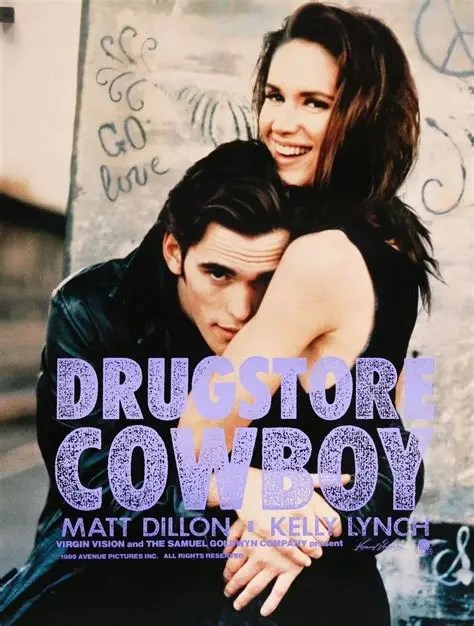
Years before ‘Trainspotting’ cemented its place in literature and film history, auteur Gus Van Sant, along with screenwriter Daniel Yost, created a brilliant film about a bunch of junkies and the rigmarole of fixing.
Here, the setting is Portland and the decade, the early seventies. Matt Dillon is the lead character, Bob, putting his brooding looks to good use, and displaying his exceptional ability to portray lowlifes, as he’d done so well in Francis Ford Coppola’s ‘Rumblefish’. He’s equally matched by his co-stars. Kelly Lynch is his salty wife Diane; James Le Gros dumbass Ricky and a young Heather Graham as manipulative Nadine completes this most dysfunctional quartet.
Essentially, they operate like a family system, with Bob and Diane assuming parental roles, but although the film is dialogue driven, the focus is squarely on the ritual of drug use, the getting, having and needing more. This is the antithesis of glamour. It’s completely unlike Tarantino who explored similar terrain in the nineties, nobody cracks wise about European burgers or participates in a Godard aping dance routine. It’s not hip for the sake of it and even the print looks grainy, as though cinema verite.
The only stylistic tics in Van Sant’s toolbox are whirling hats, laugh tracks at inappropriate times and overlapping imagery of overdoses. Really the film’s modus operandi is that junkies are deeply unlikeable and the lifestyle is both pitiful and boring- so much work robbing drugstores, only to have to do it again, on the daily. None of these people are anyone you’d like to spend time with, regardless of how attractive they are.
The film’s not on a moral crusade, though. It simply lays out the quirks, superstitions and evasion tactics of foiling families and the police alike. Best of all, ultimate drug writer and louche man about town William S Burroughs portrays Tom the priest, the local narcotics expert, in what is a thinly veiled cameo where he’s really playing himself. And as usual, Burroughs just oozes wisdom and charisma.
Everything is coated in grime here. All is rundown and crumbling. Interiors are grey. sludgy and beige. The locations echo the bleak choices the friends make, and there’s little in the way of a redemption arc on offer here. Just a gloomy, rather sordid little tale of some lost, empty people. Yet it’s an utterly compelling film, all these years later. Bob’s monologue at the end rings true , though. Don’t ever trust “the TV babies”. It’s not just drug abuse that nullifies brains.
 Hit The North
I initially watched Drugstore Cowboy during the summer of ’89 — between high school and college — via HBO. It was my first Gus Van Sant-film, and also when I first became aware of who William S. Burroughs was. Both lead to some deep, dark rabbit holes …
LikeLiked by 1 person
Absolutely. That Dr Benway and his surgery… Highly dubious! 🤪
LikeLike