There is a HELL of a lot to unpack in Penny Lane’s brilliant documentary Hail, Satan? as it seems quite jocular at first, even rather silly.
As it develops though, it seems that tone is a trick to wrong -foot any audience expectations, and a more thoughtful film emerges.Essentially, it’s all a battle of wills between one Lucien Greaves, leader of the Satanic Temple, versus organised religious groups and anyone on the right in America, defined by Greaves as representing an”increasingly theocratic” mindset.
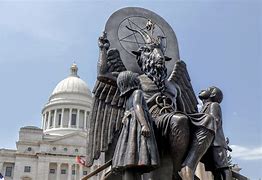
Greaves, who positions himself as an atheist and outsider, initially seems desperate to gain publicity, and is depicted by Lane as a little shambolic. But then, the followers start growing. The focus shifts towards the battle to uphold the First Amendment, becoming the Temple’s modus operandi, via the planned erection of a statue depicting the goat headed Baphomet, sitting in opposition to a tablet bearing the Ten Commandments.
Taking in kitsch horror imagery and the charismatic, if dodgy, Anton La Vey, via the “Satanic Panic” of the 80s amid the ultra- conservative Reaganites, the film shows how far the moral pendulum has swung back to Christian “traditional” values, including the anti-abortion, anti -LGBT+ brigade, more defined by what they’re against, seemingly, than what they stand for.
Meanwhile, from the film’s perspective, the Satanic crew, although a little eccentric, seem calm and lucid (except when venting into the mic) stating their own Seven Tenets, including scientific rationale, and the body as “inviolable” and autonomous .
Before long, the fights, including a Black Mass (protested by Catholics in their droves) by the Temple, become another facet of the Culture War, seemingly more ideological than purely religious.The Satanic Temple are at pains several times to point out that they don’t actively worship Satan, but as one member says, “It’s just much more interesting than just saying atheist.”.
Greaves comes across as pretty articulate and mischievous, but even he draws a line under the sand when activist, Temple member and performance artist Jex Blackmore suggests in a live performance that “we kill the President” (Trump at the time of filming). “No, we believe in non -violent protest “, he affirms. Blackmore smiles, “I’m too hot for the Satanic Temple “, as they’re ousted, with a shrug.
There are layers upon layers here then, and this is the film’s great strength. It’s as even-handed as it is complex. Nobody is the hero or villain- not even the Devil himself. Everyone’s confused, passionate and flawed, because they’re human. But I’m evangelical that everyone should see this nuanced, humorous and knotty documentary.
 Hit The North