
People often misunderstand Frank Capra’s classic Christmas film It’s A Wonderful Life. Released in 1946, it didn’t do very well initially in the United States. People found it too dark. Nowadays, many people find it too sentimental. I think both of these appraisals are a little wide of the mark. It’s both dark and sentimental, certainly, but this little gem, which eventually found its audience when screened on TV, is far more rich and complex than it’s often given credit for.
Of course it’s loosely based on Dickens’ A Christmas Carol, and the short storyThe Greatest Gift by Phillip Van Doren Stern. But it’s an exceptional character study. Jimmy Stewart’s character George Bailey is all of us- he’s ambitious but thwarted; loving but cynical, sarcastic yet hopeful. He’s a glorious mass of contradictions, and we follow him from a tough upbringing (he’s basically a wage slave from childhood who gets slapped by his alcoholic boss and is expected to forget dreams of escaping a small town) into gawky teen life, and deeper into disappointing adulthood.
People fail in Bedford Falls. They’re fallible, foolish and often hapless. They’re not good at adulting, in short. Who often hasn’t felt like that on the daily? Never enough, never grown-up, or underwhelmed by their circumstances? George Bailey is a tall, lanky repository of not feeling enough, and despite his best efforts, things are only getting worse. He tries to drown himself, until a friendly angel Clarence (Henry Travers) intervenes, and shows him what the town would be like without him.
But it’s about much more than a redemptive narrative arc. George and his lovely wife Mary (Donna Reed) are kind, and give what they can, which isn’t much. They give money to an immigrant family to help them in their new home, in one touching scene. They’re anti-capitalist by nature, opposed to Lionel Barrymore’s horrible Henry F Potter, who’d sooner see Bedford Falls turn into a seedy casino town, full of empty hedonism and big bucks. Remind you of anyone?! This is the reason for the film’s endurance: it speaks to our need for connection and community.
The Bailey family aren’t interested in vacuous, mindless rich people and their exploitation of the poor, they believe in common decency and hope. And it’s not Pollyanna in its message, this film. Lightness and dark coexists, which makes the happy ending feel hard -won. Stewart himself had served in the American army as a fighter pilot, and this is why he brings such depth, despair and euphoria to George. He understood real trauma, and brought nuance to his role.
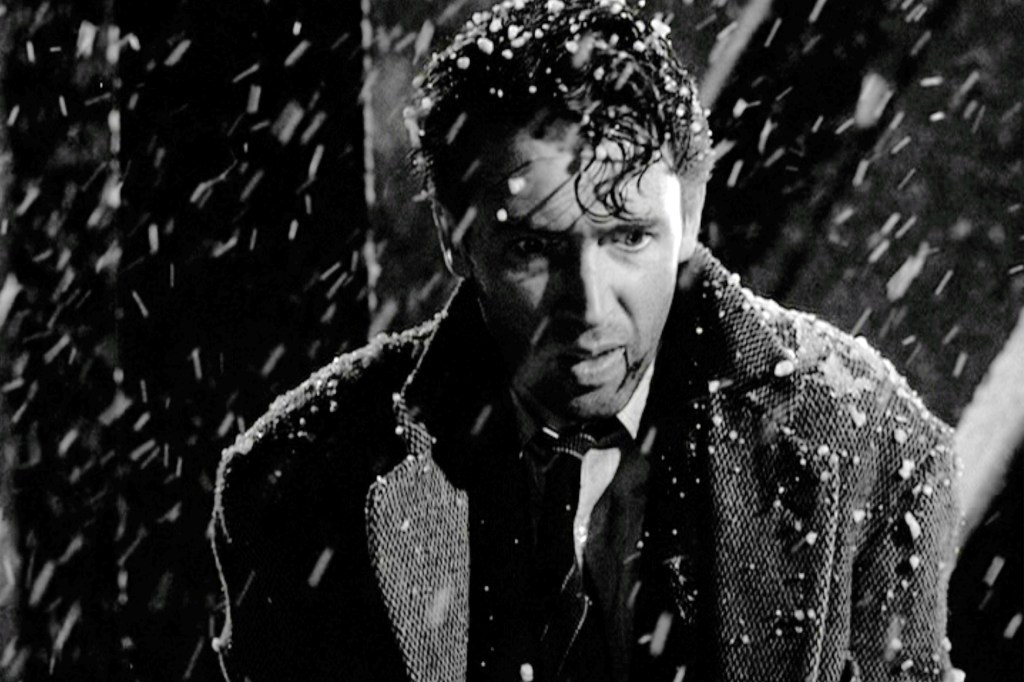
This all came at a time when “un- American activities “were about to be investigated in the McCarthy trials, and Cold War paranoia was rife in America. The scars of World War Two ran deep. It’s more than another sappy Christmas film, it’s a metaphor for standing up for the little person, championing the underdog. I’m sure we could all use this message, now more than ever. It’s truly a subversive masterpiece. Plus, try the Jimmy Stewart drinking game. Every time he says, “Well”, have a sip of something alcoholic. You’ll be merry in minutes. Can’t wait to watch it again.
 Hit The North