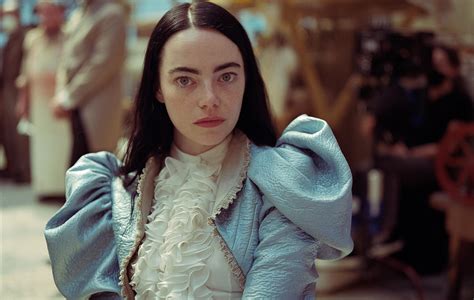
It’s been out on general release for a couple of months now, but the controversy surrounding Yorgos Lanthimos’ adaptation of Alasdair Gray ‘s Poor Things shows little sign of abating. It seems many people have missed the point.
The preoccupation with the sex (or “furious jumping” as Emma Stone’s lead character Bella Baxter calls it) has overshadowed a rather brilliant satire. It’s an unlacing of the corsetry of period dramas, a badly behaved pastiche with enough pathos to give it heart.
The film’s detractors say Emma Stone’s Bella is a toddler in an adult body when she goes off on a sexually -charged adventure across the world with Duncan Wedderburne, Mark Ruffalo’s OTT cad. She isn’t. A dead woman, revived by scientist Godwin Baxter (Willem Dafoe) who has transplanted her baby’s brain into her, she has rapidly accelerated every day, and her brain is up to reading philosophy by the time she’s reached Lisbon. So, a baby she is not. Indeed, when Bella advocates for herself, Duncan flies into an adult tantrum, no longer in control and disgusted by her independence. There’s a nod to another famous cinematic misogynist, Stanley Kowalski from A Streetcar Named Deaire, as he screams, ‘BELLA! ” outside her window.

It’s an extended metaphor for the death of Victorian Puritanism (the dead woman was called Victoria) a meditation on patriarchy, and an ode to self-actualization, through ideas, food, travel and sex. She’s unfiltered, unabashed and completely her own woman. And the keyboard prudes are having none of it – which proves the entire point the film is making. Society isn’t ready for Bella Baxter.
 Hit The North